
Single-Use Components Are Disposable. Their Traceability Shouldn’t Be.
Why component-level traceability is becoming increasingly important in pharmaceutical and biopharmaceutical manufacturing
Single-use systems have changed the way pharmaceutical and biopharmaceutical facilities are designed and operated.
Single-use bags, tubing, filters, connectors, sensors, manifolds and other disposable components can reduce cleaning requirements, shorten turnaround times and allow manufacturers to operate far more flexible facilities.
But they also create a traceability challenge that is very different from traditional stainless-steel manufacturing.
A stainless-steel vessel may remain installed for 20 years.
A single-use assembly may be installed, used for one manufacturing batch and discarded within hours.
The component disappears. The evidence of what was used cannot.
That distinction matters.
If a component defect, supplier deviation or manufacturing issue is discovered six months later, can the manufacturer determine exactly which component was used, which supplier lot it came from, where it was installed and which manufacturing batches were potentially exposed to it?
For many organisations, answering that question still means searching across ERP records, certificates, batch records, maintenance systems, spreadsheets and supplier documentation.
That is the traceability gap.
Single-use manufacturing creates a component genealogy problem
A single-use system should not necessarily be thought of as one item.
Even a relatively straightforward disposable flow path may contain numerous individual components manufactured by different suppliers and potentially originating from different production lots.
A typical assembly might contain:
- a bag
- several lengths of tubing
- multiple sterile connectors
- clamps
- a filter
- sampling ports
- valves
- sensors
- gaskets
- other product-contact components
Operationally, the manufacturer may purchase and manage that system under one assembly part number.
From a quality perspective, however, it represents an entire component genealogy.
If a supplier subsequently identifies a problem with one connector lot, tubing formulation or gasket batch, knowing the final assembly part number may not be enough.
The real questions are:
Which assemblies contained the affected component?
Where were those assemblies used?
Which manufacturing batches passed through them?
Are any affected components still installed or held in inventory?
That is where component-level traceability becomes valuable.
Regulators already recognise the risks associated with single-use systems
EU GMP Annex 1 specifically describes single-use systems as individual components or systems made up of components including bags, filters, tubing, connectors, valves, storage bottles and sensors.
Annex 1 also highlights risks including the fragile nature of single-use systems, increased manual connections, assembly complexity, extractables and leachables, and the potential for system integrity failures.
This is important because many of these risks are inherently linked to the physical component that was actually used.
A process may have been validated.
A supplier may have been qualified.
A Certificate of Conformance may exist.
But if a quality event occurs, the investigation still needs to establish the relationship between the affected component and the manufacturing process.
In other words:
Qualification tells us that the component type was suitable.
Traceability tells us which actual component or supplier lot was used.
Both matter.
Real-world examples show why this matters
The consequences of single-use component problems are not hypothetical.
In 2025, Amneal Pharmaceuticals recalled two lots of Ropivacaine Hydrochloride Injection after polypropylene fibres originating from IV bags were identified as potential particulate contamination.
The subsequent FDA warning letter described recurring visible particulate problems associated with polypropylene bags and noted that bags had previously been identified as the source of visible white fibres.
Think about that situation purely from a traceability perspective.
Once a problem is linked to a disposable component, the investigation immediately becomes a genealogy exercise.
Which supplier lots are affected?
Which manufacturing batches used them?
Are components from those lots still in inventory?
Were the same components used for other products?
How far does the potential impact extend?
The quality of the traceability record directly affects how quickly those questions can be answered.
A small defect can create a much larger manufacturing problem
Single-use systems are valuable partly because they remove the need to clean and reuse product-contact equipment.
The trade-off is that manufacturers continually introduce new physical components into the process.
Every new bag, connector, tubing assembly or filter introduces another manufacturing history.
And sometimes very small defects matter.
An FDA-recorded recall involving sterile EVA bags identified the potential for pinhole leaks near a seal, with the possibility that the defect could result in a breach of sterility. The recall was associated with a specific manufacturing lot.
A pinhole is a tiny physical defect.
Its potential impact is not.
The same principle applies across single-use manufacturing.
A poorly formed weld can compromise a bag.
A damaged sterile connector can compromise a closed system.
A filter defect can affect process integrity.
An unsuitable polymer can introduce extractables or particulates.
A gasket or seal failure can compromise containment.
The cost of the disposable component may be insignificant compared with the value of the product that has passed through it.
The traceability challenge does not stop at the bag
Bags tend to receive a lot of attention because they are highly visible single-use components.
But the real challenge is broader.
Consider a disposable transfer assembly containing tubing, sterile connectors, a filter, valves and several seals.
A supplier may subsequently notify the manufacturer that a specific batch of sterile connectors has a potential defect.
The manufacturer now needs to determine whether that connector batch was incorporated into any assemblies supplied to its facility.
If it was, the next questions are obvious.
Where were those assemblies used?
When were they used?
Were they used in production?
Which batches were processed through them?
Are any assemblies containing the affected connector still in storage?
Without component genealogy, answering those questions may require contacting the single-use assembly supplier, reviewing purchasing records, checking supplier certificates, searching manufacturing documentation and manually reconciling the results.
With connected traceability, the investigation can be much more targeted.
From component to finished product
The goal should be relatively simple.
A manufacturer should be able to trace a critical single-use component through its lifecycle:
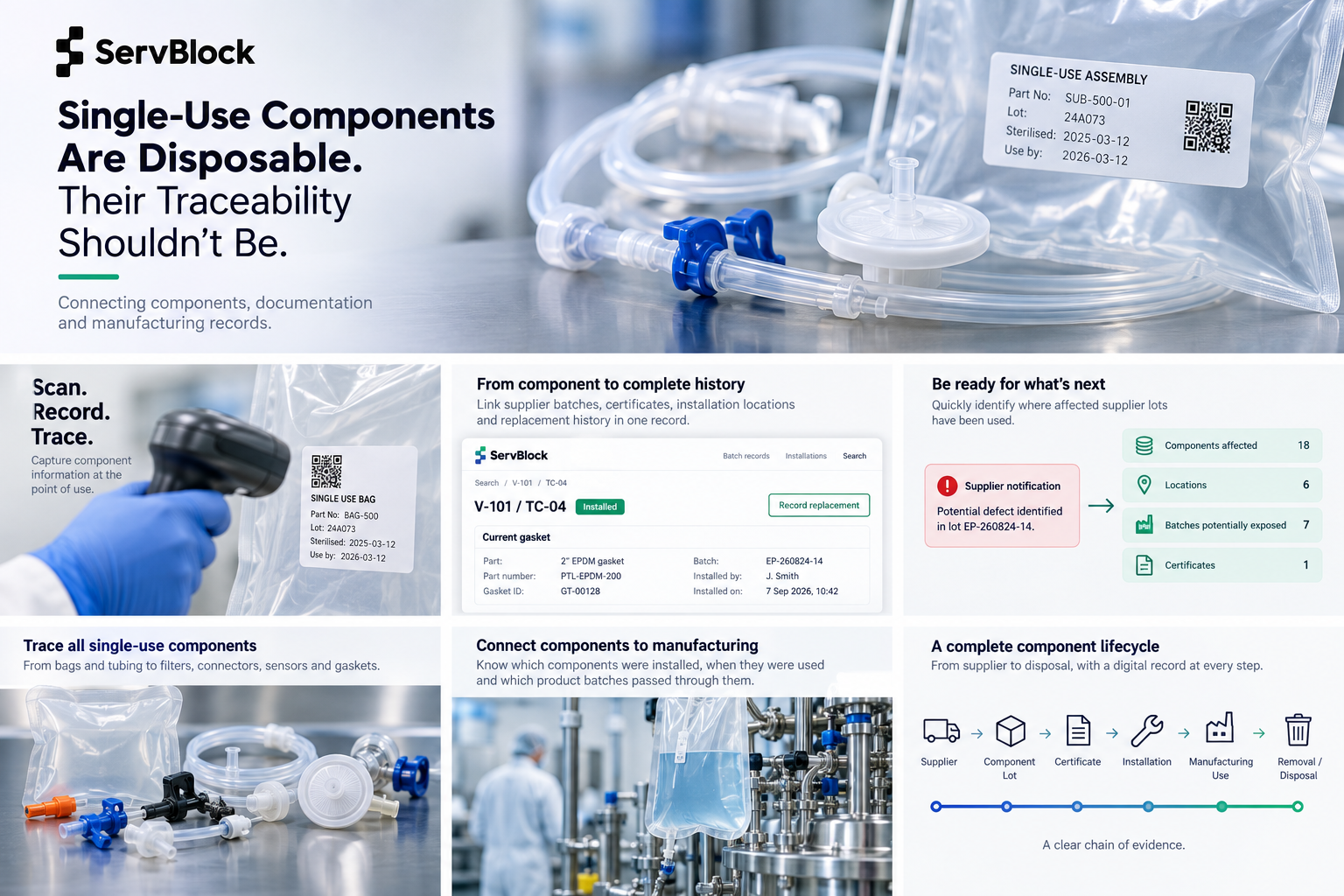
Supplier → Supplier Lot → Component → Assembly → Certificate → Installation → Equipment → Manufacturing Batch → Removal or Disposal
The power comes from the relationships between those records.
Most manufacturers already hold much of the information.
The supplier information may exist in ERP.
The Certificate of Conformance may be stored in a document management system.
The installation may appear in a maintenance record.
The manufacturing batch may exist in an electronic batch record.
The component lot may be written on a paper form.
Individually, each record may be perfectly acceptable.
The problem appears when someone needs to reconstruct the complete history.
A collection of documents is not necessarily the same thing as traceability.
A simple gasket illustrates the principle
A gasket is one of the simplest examples.
It may cost only a few euro, but it is still a product-contact component.
Imagine a 2-inch EPDM gasket installed at connection V-101 / TC-04.
A traditional maintenance record might simply state:
“Gasket replaced.”
That confirms that work occurred.
It tells us relatively little about the actual component.
A digital component record can instead associate the installation with:
- the specific part number
- component ID
- supplier batch
- installation date
- installer
- Certificate of Conformance
- previous component
- removal and replacement history
That produces something much more useful than a maintenance record.
It creates a history of the physical components that formed part of the manufacturing system.
The same model can then be applied to much more critical and complex single-use components:
- bag assemblies
- filters
- tubing
- sterile connectors
- manifolds
- sensors
- sampling assemblies
- complete disposable flow paths
Imagine receiving a supplier notification six months later
Suppose a manufacturer receives the following notification:
Potential defect identified in supplier lot EP-260824-14.
There are two very different ways the next few hours can unfold.
In the first, Quality searches ERP to determine how much material was purchased.
Warehouse personnel check stock.
Engineering searches work orders.
Manufacturing reviews batch documentation.
Certificates are retrieved from another system.
Individual departments are contacted to determine whether any affected components are still installed.
The information is gradually assembled into a spreadsheet.
Eventually, the organisation establishes the potential impact.
Now consider the same event with connected component traceability.
Search:
EP-260824-14
The manufacturer can immediately determine:
- how many components were received
- how many remain in inventory
- which have already been used
- where remaining components are installed
- when each component was installed
- which manufacturing batches were associated with those installations
- which certificates and supporting records apply
The defect has not changed.
The quality investigation has.
Traceability can reduce the scope of investigations
This is an important point.
More traceability does not necessarily mean identifying more affected product.
Quite often it can do the opposite.
If a manufacturer cannot determine where a particular supplier lot was used, the investigation may have to consider a much broader population of product.
Uncertainty increases the potential scope.
Detailed genealogy allows that population to be narrowed using evidence.
Instead of asking:
“Which batches might have used this type of component?”
the organisation may be able to ask:
“Which batches were manufactured while these specific components were present?”
That is a much more powerful question.
Single-use manufacturing makes this more important, not less
In a traditional stainless-steel facility, much of the physical manufacturing system is relatively static.
In a single-use facility, parts of the physical process may effectively be rebuilt every time a new assembly is installed.
A new manufacturing batch can mean:
- a new bag
- new tubing
- new connectors
- a new filter
- new supporting documentation
- new supplier lot numbers
The configuration can change from batch to batch.
That creates enormous flexibility.
It also makes the ability to reconstruct the exact manufacturing configuration increasingly important.
Future investigations may need to establish not only which equipment produced a batch, but also:
Which disposable components physically formed that equipment configuration at that point in time?
Supplier changes add another layer
Single-use supply chains also change.
Component manufacturers may change:
- raw materials
- resin suppliers
- manufacturing locations
- moulds
- component designs
- sterilisation processes
- production equipment
- packaging
- sub-suppliers
An assembly manufacturer may substitute one approved component for another.
A tubing formulation may change.
A connector revision may be introduced.
A filter manufacturing location may move.
Each change creates another reason why simply recording an assembly part number may not provide enough information.
Good genealogy allows the manufacturer to establish not only what type of component was used, but potentially which version, supplier lot or manufacturing source was used.
That becomes particularly valuable when investigating quality trends that only become visible months after a change has been introduced.
The practical solution: capture traceability at the point of use
Component traceability should not mean asking operators to complete more paperwork.
The most effective approach is to capture information as part of the normal manufacturing workflow.
A barcode, QR code, RFID tag or other machine-readable identifier can connect the physical component with its digital record.
At receipt, the component can be associated with:
- supplier
- part number
- supplier lot
- expiry information
- sterilisation details
- quality documentation
- material information
At installation, the operator scans the component and the installation location.
The system records:
- who installed it
- where it was installed
- when it was installed
- what component it replaced
When the component is removed, that event becomes part of the same history.
When manufacturing occurs, the component installation period can be associated with the appropriate manufacturing records.
The genealogy is created through normal activity rather than reconstructed retrospectively.
From single-use component traceability to manufacturing genealogy
This is where the real opportunity lies.
Knowing which components are installed is useful.
Connecting those components to the material or product that passed through them is far more powerful.
Imagine being able to start with a finished pharmaceutical batch and move backwards through its manufacturing history:
Finished Product Batch
↓
Manufacturing Process
↓
Equipment / Process Location
↓
Single-Use Assembly
↓
Individual Components
↓
Supplier Lots
↓
Certificates and Source Documentation
And just as importantly, being able to perform the search in reverse.
Start with a supplier lot affected by a quality notification and determine:
- which assemblies contained it
- where those assemblies were used
- when they were used
- which manufacturing batches were potentially exposed
That is digital manufacturing genealogy.
Where ServBlock fits
At ServBlock, we believe traceability should extend beyond knowing that a material entered a facility.
The objective is to connect the physical component to the evidence surrounding its use.
For single-use manufacturing, that means connecting:
- component identity
- supplier lot information
- certificates
- installation location
- manufacturing use
- removal and replacement history
- associated manufacturing batches
into a searchable digital record.
The example shown here is deliberately simple: a gasket linked to its supplier batch, Certificate of Conformance, installation location and change history.
But the same principle can extend across a complete single-use manufacturing process.
Bags. Tubing. Filters. Connectors. Valves. Sensors. Gaskets. Complete assemblies.
The result is not simply another repository of documents.
It is a connected record showing:
what was used, where it was used, when it was used and what manufacturing activity it potentially touched.
When a supplier issue, deviation or investigation occurs, that distinction can make a significant difference.
What if you could search a supplier lot and immediately see every manufacturing batch it touched?
That is the level of traceability ServBlock is working to enable.
As pharmaceutical manufacturing becomes increasingly flexible and single-use systems become more complex, component-level traceability has the potential to become an important part of digital manufacturing genealogy.
If your organisation is working with single-use systems and wants to explore how component, supplier and manufacturing records can be connected, talk to ServBlock.
See how ServBlock can build traceability from supplier lot to manufacturing batch.